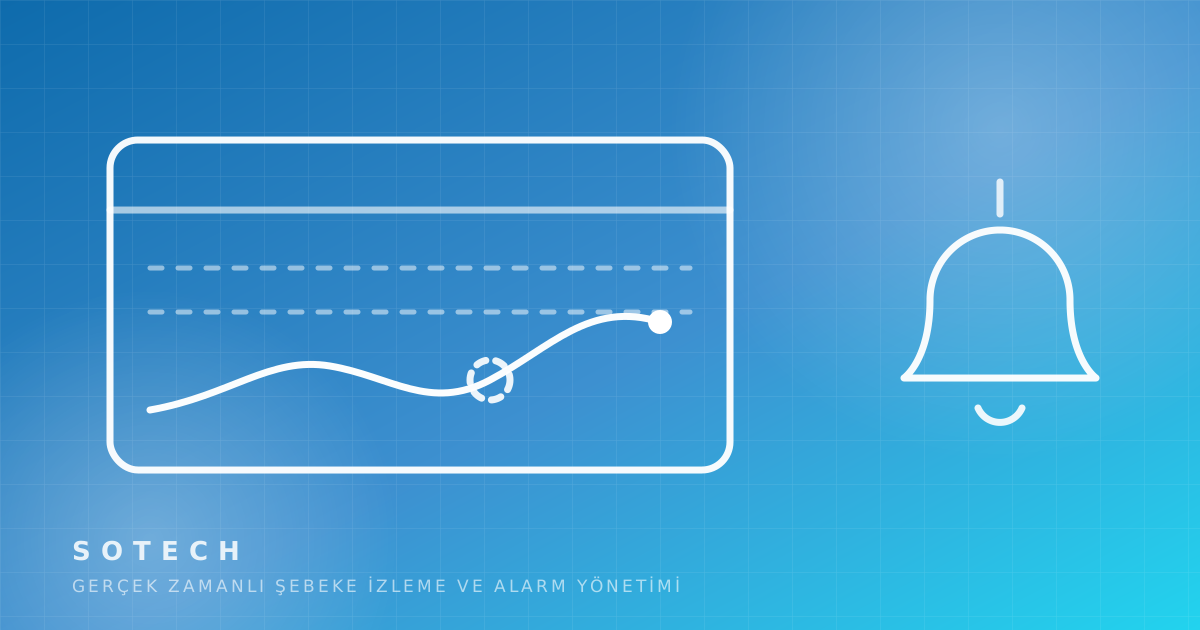
A system that raises too many alarms can be more dangerous than one that raises none. We explain how alarms must be designed so the operator can actually see the event that needs intervention.
Every organization that deploys a monitoring system starts with the same expectation: to see what is happening on the grid the moment it happens. A few weeks after go-live the picture is often different — so many alarms pile up on screen that the operator starts dismissing them all. At that point the system is technically working but has lost its purpose.
Alarm fatigue is a design fault, not a user error
A measurement oscillating around a threshold can, with naive logic, raise dozens of alarms a minute. The answer is not to raise the threshold but to design the alarm's behaviour: separating on and off thresholds with hysteresis, filtering brief excursions with delays, suppressing indicators that become meaningless at low load. These are not comfort features; they are the condition for the system remaining usable.
The second issue is how silence is interpreted. A measurement point that stops reporting does not mean "no problem"; more often it means "we have lost contact". A monitoring system without dead-point detection can mistake its most critical fault for calm.
A closed alarm is not a solved problem
It is normal for an alarm to clear when its condition disappears. But an alarm that closes without anyone seeing it vanishes without leaving a trace. A healthy lifecycle requires acknowledgement, shelving where appropriate, bulk handling, and separate flagging of events that closed unacknowledged. Open alarms surviving a system restart is part of the same integrity.
- Threshold sets are derived from standards and regulatory bands, not guessed by hand
- Hysteresis and delays cut false alarms at the source
- Dead-point detection catches the measurement point that went quiet
- Events that closed without acknowledgement are flagged; nothing closes unattended
The limit of monitoring: recommend, never command
How close should a monitoring system get to operational technology? Our choice is explicit: read-only. The system can produce a criticality-aware load shedding recommendation from its loading analysis, but it never writes commands to the grid. The decision to intervene always stays with the operator — the right boundary for both safety and accountability.
A good monitoring system is not the one that shows a lot, but the one that shows the right thing.
We built GeoEner PSM on these principles: live telemetry, deliberately designed alarm behaviour, loading and transformer thermal analysis, and early warning on regulatory risk. Let's talk about how it would sit on your shift team's screen — reach us via our contact page.
Let's plan this transformation together
We can bring what we covered in this article to life for your organization. Tell us your needs and we'll draw up a roadmap tailored to you.